
Hotel software explained
Hotel PMS vs hotel ERP: differences, integration and which one you need
A PMS runs the stay. An ERP runs the business behind the stay. Many hotels need both. The important decision is where each source of truth lives and how the records reconcile.
Short answer
The boundary is guest operations versus enterprise control.
A hotel property management system (PMS) is centred on reservations, rooms, rates, guests, folios, check-in, check-out, housekeeping status and night audit.
A hotel enterprise resource planning system (ERP) connects accounting, procurement, inventory, suppliers, assets, maintenance, HR, payroll, approvals and multi-property control. A hospitality ERP also understands that those back-office records begin with hotel events rather than generic invoices alone.
Full-suite claims
“All-in-one” does not define the system boundary.
Terms such as full-suite, all-in-one and hotel management software are product labels, not standard definitions. A shortlist should therefore be compared by record ownership and reconciliation, not by the label on the brochure.
| Product description | What it may include | What to verify |
|---|---|---|
| PMS-led hotel software | Reservations, rates, folios, front desk and housekeeping | How accounting, purchasing, inventory and payroll are controlled |
| All-in-one hotel suite | A broad mix of guest and back-office modules | Whether finance and supply records are native, exported or manually reconciled |
| Connected PMS and ERP | Specialist stay operations plus enterprise control | Source ownership, posting cut-off, error handling and reconciliation |
For a practical view of the back-office boundary, see how hotel accounting, procurement and inventory connect.
Quick decision matrix
Match the architecture to the operating problem.
Property size alone does not decide the answer. The stronger signals are the number of operational systems, the volume of manual reconciliation and whether management needs one controlled view across properties.
| Hotel situation | Likely fit | What to verify |
|---|---|---|
| Small single property with simple back office | Capable PMS plus controlled accounting | Folio export, cash control, tax configuration and month-end reconciliation |
| Full-service hotel with F&B, stores and payroll | Hotel-native PMS and ERP, or a connected pair | POS posting, recipe and stock consumption, procurement approvals, payroll journals and error queues |
| Multi-property group | PMS layer plus central ERP control | Property access, shared suppliers, inter-property work and consolidated finance |
| Brand-mandated or deeply integrated PMS | Keep the PMS and connect an ERP | Ownership of master data, posting cut-off, retry behaviour and reconciliation |
Side-by-side
What each system normally owns.
| Business area | Hotel PMS | Hotel ERP |
|---|---|---|
| Reservations & rates | Primary owner | Receives revenue and forecast context |
| Guest folios & night audit | Primary owner | Receives controlled postings |
| Housekeeping room status | Primary owner | May own labour, linen and supply cost |
| General ledger & financial close | Often limited or exported | Primary owner |
| Procurement & suppliers | Usually limited | Primary owner |
| Inventory & recipe costing | May cover minibar/POS items | Primary owner of value and consumption |
| Assets & engineering | May flag room faults | Primary owner of equipment, work and cost |
| HR, attendance & payroll | Usually outside | Primary owner |
| Multi-property control | Rooms and reservations | Finance, supply, people, assets and access |
See the ERP boundary
Inspect the records behind the management view.
An ERP dashboard should be the start of the audit trail, not the end of the explanation. In a product demonstration, ask to move from each headline number to the stock, asset, work-order or food-cost records that produced it.
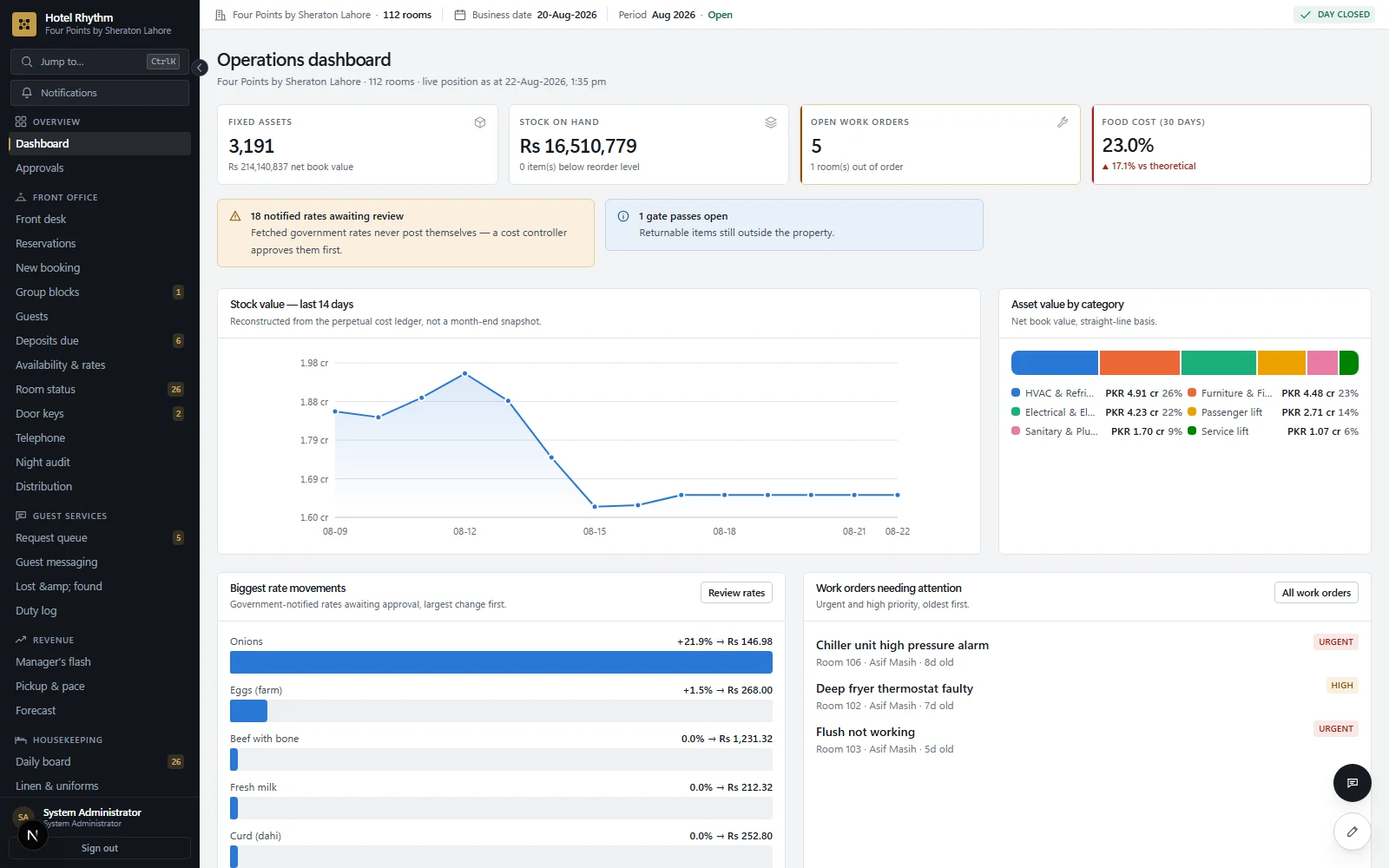
- Open the transactions behind a dashboard total and trace who recorded and approved them.
- Change the property context and confirm that permissions and reporting boundaries follow it.
- Follow one operational event through its inventory, supplier and general-ledger effects.
Three sensible architectures
One stack is not automatically better.
1. Native PMS and ERP
Best when an independent hotel wants one vendor and one transaction chain from reservation to financial statements. It reduces interface work, but the native PMS must still meet the front office's depth and distribution needs.
2. Specialist PMS connected to ERP
Best when an existing PMS is strong, required by a brand, or deeply integrated with distribution and guest systems. The interface must have explicit ownership, failure handling and reconciliation.
3. PMS plus accounting package
Often sufficient for a small property with simple procurement, inventory and people processes. It becomes fragile when spreadsheets carry approvals, stock, assets or inter-property work.
Pakistan buyer checks
Test the operating fit, not only the feature list.
For a hotel in Pakistan, the shortlist should be tested against the property's actual billing, finance, support and connectivity conditions. Regulatory and tax requirements can vary by business and jurisdiction, so validate the current configuration with qualified advisers rather than relying on a generic compliance badge.
- Can invoices, taxes, currencies and the chart of accounts be configured for the property's approved process?
- Can the team receive implementation and support in the languages and working hours it needs?
- What continues to work during an internet or interface interruption, and how is missed data recovered?
- Can one property keep a required PMS while finance and procurement remain centrally controlled?
- Does the demo show real reconciliation, approval and exception workflows rather than dashboard totals alone?
For a broader procurement process, use the Pakistan hotel software buyer's guide.
Integration test
Ask what happens when the interface fails.
An integration slide is not an operating control. For every connection, document the source, destination, record key, frequency, cut-off, error queue, retry behaviour, reconciliation report and person responsible for exceptions.
- Can the same folio or check be imported twice?
- What stops a room revenue total from posting to the wrong business date?
- How does finance see missing or rejected records before close?
- Can the hotel replay a failed batch without creating duplicate journals?
- Which system owns corrections after night audit?
Frequently asked questions
Hotel PMS and ERP questions, answered directly.
What is the main difference between a hotel PMS and a hotel ERP?
A hotel PMS primarily manages the guest stay: reservations, rooms, rates, folios, check-in, check-out, housekeeping status and night audit. A hotel ERP primarily manages enterprise control: accounting, procurement, inventory, suppliers, assets, maintenance, HR, payroll, approvals and multi-property reporting.
Does full-suite hotel software include both a PMS and an ERP?
Not necessarily. Full-suite and all-in-one are product labels, not standard definitions. Some suites cover the guest journey but export finance and purchasing; others include both hotel operations and enterprise control. Verify which system owns reservations and folios, which owns accounting and supply, and how the two sides reconcile.
Can a hotel ERP replace a PMS?
Only when the ERP includes a hotel-native PMS that meets the property's front-office, rate, folio, housekeeping and distribution requirements. Otherwise, the safer design is usually a specialist PMS connected to the ERP with documented posting, error-handling and reconciliation controls.
Does a small hotel need both a PMS and an ERP?
Not always. A small single-property hotel may be well served by a capable PMS plus a controlled accounting process. An ERP becomes more valuable when procurement, stock, payroll, assets, approvals or multi-property reporting are being managed through disconnected spreadsheets and repeated data entry.
Can a hotel keep an existing or brand-mandated PMS?
Yes. The PMS can remain the source of truth for reservations, folios and stay operations while a connected ERP controls finance, procurement, inventory, people, assets and consolidated reporting. The integration boundary and exception process must be explicit.
Which system should own hotel inventory and accounting?
The ERP should normally own inventory value, purchasing, supplier balances, the general ledger and financial close. A PMS or POS may record operational consumption and guest charges, but controlled postings and reconciliations should connect those events to the ERP.
Decision rule
Choose the smallest architecture that preserves one trustworthy answer.
If the hotel can explain room revenue, cash, receivables, stock, payables and profit without manual re-keying or uncontrolled spreadsheets, the architecture may be enough. If it cannot, evaluate the missing ERP layer.